Blood work
Your blood test came back "mostly fine". Until you see who it compares you to.
A normal result is good news. It also says less than you think. Here is how the medical system reads your blood test, and how we read the same one.

What a doctor admitted
I regularly speak with the doctors who oversee our members alongside us.
This one had just seen his patient's cholesterol and several other markers improve. He was impressed and wanted to know what we had done. I came into his clinic to talk to him, and we had a great exchange.
Then he admitted something.
"I know it's not ideal, but that's how the system is designed. You're healthy until you're not, and then we medicate. There's not a lot of prevention."
Two ways to read the same blood test
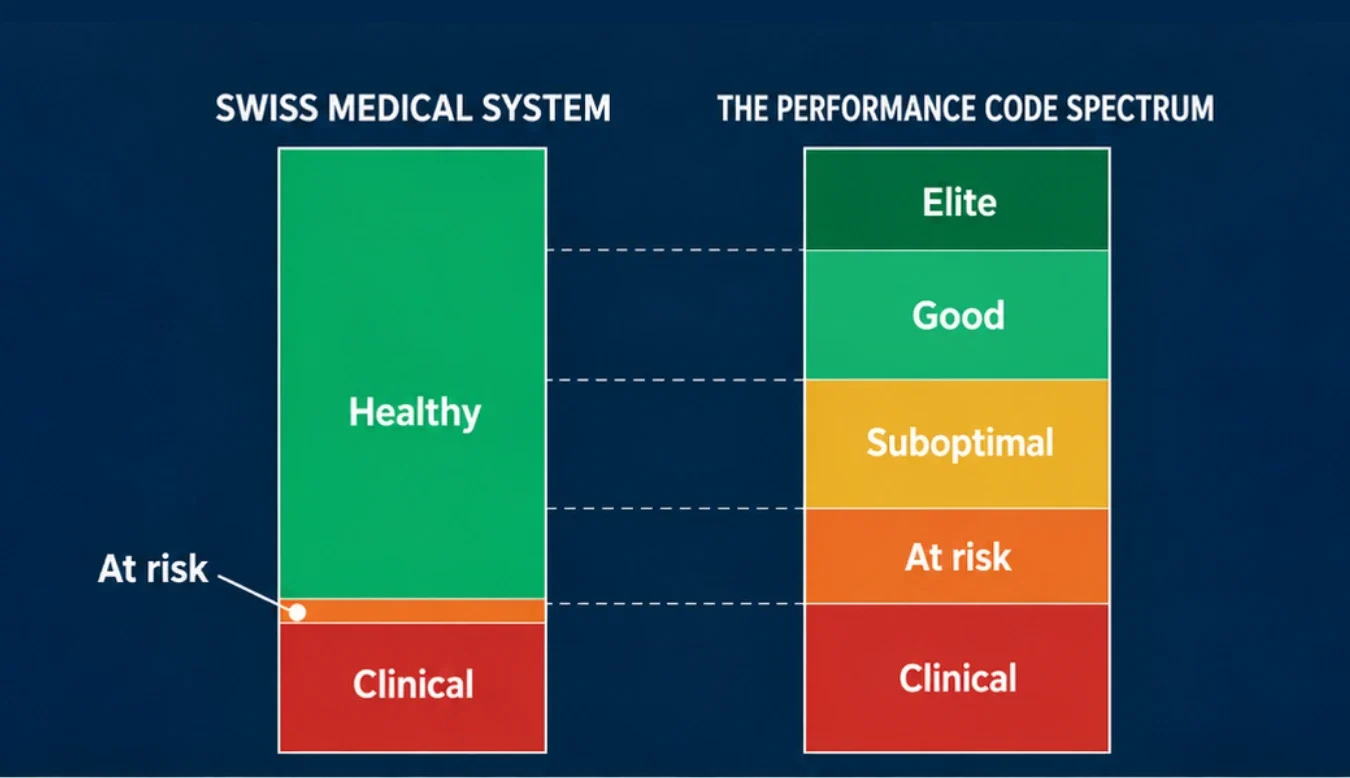
The left side is the system. Green or red. The orange in between is a split hair.
The right side is how we read the same blood test. Elite, good, suboptimal, at risk, clinical.
Everything above clinical counts as healthy in the system. A man can drift from good to at risk over 10 years and hear "all good" at every check-up.
Your doctor's reference point is his waiting room

He spends his days with people who are ill. Next to them, "not that bad" is a fair call. The men with excellent markers rarely sit in his office.
The range on your lab report has the same problem
It describes the population and says nothing about what is ideal.
Many labs simply adapt the range from the maker of the testing device. That range is often based on a population sample from the US, where the machine comes from.
No board would accept "in line with the market average" as a performance review. Your lab report does exactly that.
Why the extra markers stay off the panel
Testing beyond the basics takes work too. Every extra hormone or cardiovascular marker has to be justified to the insurer. A hormone result can mean a referral to an endocrinologist. So the extra marker usually stays off the panel.
His job is to keep you out of the red zone. Running at your best was never part of it. That part is yours.
How we read your blood work
That is why we work with several doctors, and why Dr. med. Yannis Karrer, our Medical Advisor, is now part of The Performance Code. His specialty is blood work and lifestyle intervention.
Our members test at partner labs. They walk in, get tested, and the results come straight to us.
Then everything goes into the Performance Index, measured against the top of the spectrum.
If your last blood test came back "normal", ask where in the green you are.